NukeMap is considered harmful.
NukeMap misinforms the public about the damage nuclear weapons can inflict.

NukeMap is not nearly as accurate as people might think. It’s a very simplistic approximate simulation that very likely understates the damage that can be done by a nuclear blast. I didn’t expect it to be accurate yet did not expect it to be quite as inaccurate as it appears to be.
By default with simulations like this we tend to be conservative. From a computer science background we usually would add the effects that are easiest to simulate and that we can be more certain about.
Anything more difficult to simulate or estimate will tend to get left out. It’s probably more accurate if you want a sense of the minimum damage. Though it is incredibly crude even in spite of that. To give an example it uses a very low resolution gradient for things like psi.
I believe it’s probably fairly accurate for very low yield devices in the range of Hiroshima and Nagasaki. These have actually been dropped on small cities so we have a lot of data for that to compare to.
Larger yields have more complex effects that are more difficult to predict and while they have been tested they haven’t actually been used in full strategic strikes to get the full data.
It’ll likely start ailing even after a few hundred kilotons. The larger the yield the more likely it to have some more effects at a distance that are unaccounted for.
Even the light damage from large nukes can become a major problem because of the huge scale of damage. A few broken windows and roofless houses isn’t a problem. Virtually every house in a town or city losing their windows and roofs is a different matter.
When we look at what NukeMap predicts for the Tsar bomb and when we actually look at the test results for the Tsar bomb it looks as though it significantly underestimates the damage.
I have illustrated this by running nuke map’s simulation of the Tsar bomb where it was actually tested and then added the test results of the Tsar bomb to the map.
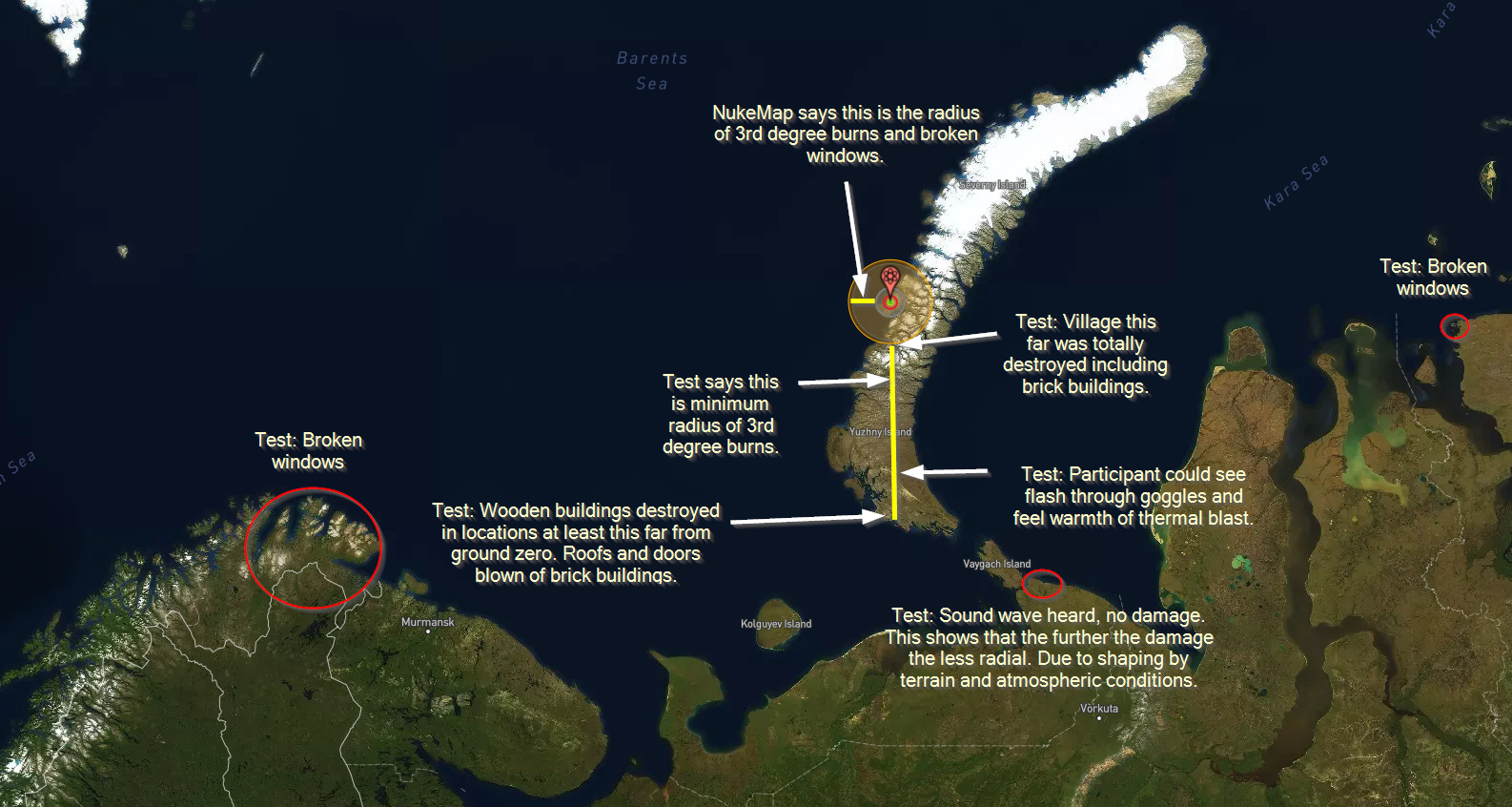
Despite being aware of NukeMap’s limitations I never really expected it to be so far off. I’ve always felt a sense of there being a mismatch with it because before NukeMap I’d studied things like the Tsar bomb test and remember coming to the conclusion that it could potentially ravage much of Britain. In a certain sense a single bomb that could destroy the entire country.
When you run it on NukeMap it comes off as far less severe than what I remember from studying the actual test of the Tsar bomb. I think NukeMap may almost be dangerous in understating the potential impact of a nuclear strike.
I don’t know how inaccurate it is for more likely yields for strategic nuclear strikes. I do know it is missing a large amount from damage estimations for those and is not telling the whole story.
If in addition to that it’s understating things similarly to the extent it appears to be with the Tsar bomb then people will be grossly mislead by it. It’s already missing so many things I don’t know where to start. With this potential error it appears to be doing so two fold.
I’d expect NukeMap to under state things a little as the Tsar bomb was probably 58Mt. Though even switching to 100Mt doesn’t fix much.
We’re used to people overstating things sometimes. The assumption that a nuclear strike must kill millions of people. In Planet of the Apes there is the rather ridiculous perception that a single nuke would blow up the entire planet. Many people also mistake nuclear winter for nuclear ice age.
I believe in this case NukeMap grossly underestimates the damage a strategic nuclear strike could really do. People today have forgotten about the potential horrors of nuclear war. Historically people lived through an era of actual nuke tests not nuke map so probably had a more realistic idea sometimes.
It turns a bomb that could cause severe country wide damage if it were deployed against England to one that would only destroy half or more of London. On NukeMap it will show a bomb the effects of which are confined to a 60km radius but when the bomb was actually tested for real the effects extended to a distance of almost 1000km! This is a major discrepancy.
Could this fix it?
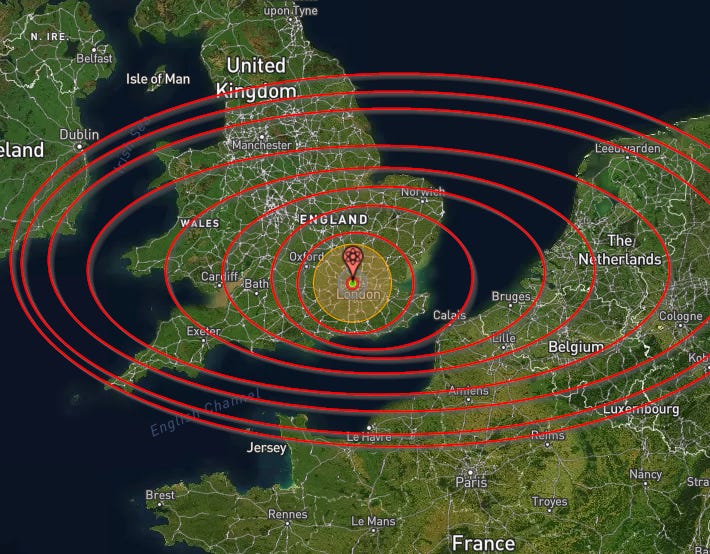
Probably not. The damage profile would likely be far more complex than this. Though something like this is probably where we might start to include some of the things NukeMap seems to leave out.
As the effects emanate out they likely look more like an egg splat and then a tentacle monster. Several things may channel the blast including the immediate asymmetries where it strikes, asymmetries in the bomb itself and then the state of terrain and atmosphere.
Based on dropping a real Tsar bomb on a real Earth rather than what might as well be so far departed from the real thing it’s barely better than tossing a wedding ring on a map these rings do at least represent the various potential reaches of destructive effects.
This will not be consistent the greater the range or more varied the terrain. A village behind a hill fairly close by might be spared where as a village several times more distant might not be. The sphere of destruction projected by NukeMap tends to be more absolute or closer to 100%. Beyond that the percentage or coverage drops off though at exactly what rate is difficult to say.
If I were using NukeMap to project losses in a game of world domination it might give the impression of acceptable losses and that we would survive. When I consider plausible worse case scenarios within the enormous margins of error for NukeMap then nuclear war with Russia goes from tenable to untenable.
Something that is funny about this is it looks a little like the mistake you might make if you treated a thermobaric bomb as a conventional bomb. The Tsar bomb is a thermonuclear bomb. If the tool is using a single formula that takes yield as an input the scale ranges from fission to fusion.
I doubt it’s as simple as that but this is probably one in a great many difficulties with a simulation like this. The number of things that can go right is ultimately only one. The number of things that can go wrong is infinite.
NukeMap is one of many potential sources of dangerous misconceptions about nuclear war. These aren’t always something that needs to be combated directly. The greater issue is what’s missing. There is an enormous lack of education on the threat of nuclear war.
Most people don’t really know about it and don’t even understand the basics. The greatest taboo is not using nuclear weapons. The greatest taboo is to bring about situations where a nation either must use nuclear weapons or has a fair reason to.
Common thinking about nuclear warfare tends to be socially constructed and dangerous. People seem to think of war like some kind of sport with imaginary rules that don’t exist in reality. Nuclear weapons are weapons like anything else.
Some of these fantasy rules are dangerously self serving. We believe that if we attack Russia with conventional forces where we have an overwhelming advantage then it’s not allow to use nuclear weapons to level the playing field. This thinking will guarantee nuclear war.
Psychologically people tend to have a kind of dissonance though not a concurrent one. Depending on the implications of a given discussion they will have arguments for why nuclear war won’t happen and why it will happen which is more dependant on what they want or don’t want than actual reality.
This also applied to the severity of nuclear war. If someone wants something really badly but they can’t argue away the risk of nuclear war then they will instead downplay the severity.
One misconception revolves around the yields of nuclear devices and accuracy. There is an argument that higher yield devices we necessary because of poor accuracy. There’s some truth to this but it’s not the whole truth.
Some people confuse tactical strikes or more limited strategic strikes with all out nuclear war to the maximum extent. Yield versus quantity is quite complex. Sometimes a one megaton device is best and sometimes you can do more damage with ten 100 kiloton devices. In either case you’re still getting hit with 1 megaton.
The low yield argument works well for smaller targets where high yield is overkill but less so for larger strategic targets such as megacities. When aiming for total depopulation there’s no shortage of targets to strike.
The most extreme strategic nuclear deterrent is that of complete destruction to the maximum extent. Based on people I’ve talked to if I were an adviser to Putin then I would inform him that Russia’s present nuclear deterrent is insufficient.
Many people are no longer sufficiently deterred including in cities such as London. I suspect they are not deterred in government either or in organisations such as NATO. I do not believe that Russia’s present arsenal and posture is sufficient to ward of attack.
I would advise Putin to resume nuclear testing and mass production of weapons of mass destruction to the capacity of being able to ensure the total and complete destruction of Europe and North America.
Believe it or not, at least some first strike scenarios that are plausible and a number of arguments for nuclear war with Russia present cases where for the gains the damage is acceptable. It may be hard for some people to understand this.
The world looks very different when you look at it as a machine and disregard some of the human element. You would be surprised what the most reasonable and rational minds can reason and rationalise.
Simulations that may significantly understate the damage of nuclear strikes such as NukeMap are particularly useful for this line of persuasion. Russia performing a nuclear test to remind people of the actual damage potential might change that.
Conflict is not a constant. The assumption of strategic warfare striking cities with one big explosion to rule them all is likely very wrong. An evolving strategic deterrent will likely consider many options.
A city such as London might be best destroyed with first a strike from first several dozen devices emanating from a single war head striking the ground broadly across the city and then slightly later a single or few megaton air burst warheads. Perhaps some other such combination.
Though strikes being purely nuclear in nature and hitting cities may be a mistake. Cities are a population sink in most cases. They also do not produce all that much. An ideal strategy largely ignores them.
Instead you strike the industry, economy and resources. Spoliation of vast tracts of arable land for example. This can rely on chemical and biological strikes as well as nuclear.
The destruction of significant industry, infrastructure, commercial zones, mines, etc. Highly developed and densely populated targets in Europe live well beyond their means. If you don’t hit cities and leave large proportions of the population intact then you make create an even larger disaster.
The ultimate purpose of strategic nuclear deterrence is to be able to do as much damage as you can that is as nasty as possible. The goal is to be able to inflict the most ultimate horror on your enemy to deter them.
Ten million people dead from a nuclear strike is relatively clean. Ten million dead from starving and eating each other alive is different. Populations can also regrow faster than people might realise. Targeting that capacity is crucial.
If the damage is eventually recoverable according to some foreseeable time frame then the deterrent is insufficient. I could easily make the argument that for people in two hundred years time it would be as though it never happened other than that they would be better off for it. All the people dead would have died anyway and everything has been rebuilt.
For someone such as myself to be entirely deterred from taking Russia, a mighty prize on many fronts then their deterrent needs to be far more significant than it already is.